- Membrane cells produce about 32 % caustic soda with very little salt, against roughly 10–12 % for diaphragm cells.
- Less evaporation means less steam, lower energy bills and a lower carbon footprint.
- The success of a conversion depends first on brine purification and on a phased project plan.
The chlor-alkali process turns salt and water into three essential products: chlorine, caustic soda (NaOH) and hydrogen. The chemistry has not changed in a century, but the technology used to separate them has — and it now makes a large difference to a plant's energy bill, product quality and regulatory risk. For many producers in Africa and the Middle East, a membrane cell conversion is the single most profitable modernisation project available.
Three technologies, one reaction
All chlor-alkali plants run the same electrolysis: 2 NaCl + 2 H₂O → Cl₂ + H₂ + 2 NaOH. What differs is how the anode and cathode compartments are kept apart:
- Mercury cells use a mercury cathode. They are being phased out worldwide, notably under the Minamata Convention on mercury.
- Diaphragm cells use a porous diaphragm, historically made with asbestos and now often with polymer-based materials. Brine flows through it, so the caustic soda leaves the cell diluted and mixed with salt.
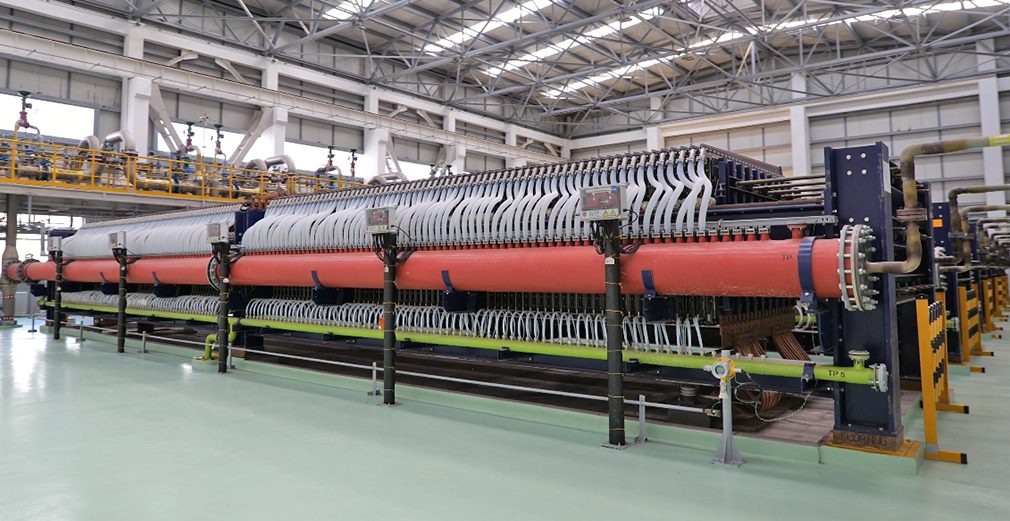
- Membrane cells use an ion-exchange membrane that lets sodium ions through but blocks chloride ions. This is today's reference technology, used for example in INEOS BICHLOR™ bipolar electrolysers.
Membrane vs diaphragm: the comparison that matters
| Criterion | Diaphragm cell | Membrane cell |
|---|---|---|
| Caustic soda at cell outlet | About 10–12 % NaOH | About 32 % NaOH |
| Salt in caustic soda | Around 1 % NaCl | Very low (high-purity grade) |
| Steam for evaporation to 50 % | High | Low |
| Overall energy consumption | Higher | Generally the lowest of the three technologies |
| Environmental and health risk | Asbestos in older designs | No asbestos, no mercury |
| Brine purity requirement | Moderate | Very high (ppb level for calcium and magnesium) |
The last line is the price of the membrane's performance: the membrane is sensitive to impurities, so brine purification must be upgraded. We explain how in our guide to brine purification for membrane electrolysers.
Why convert now
Four drivers usually trigger a chlor-alkali plant modernisation:
- Energy costs. Electricity and steam are the largest operating costs of a chlor-alkali plant. Producing stronger caustic soda directly at the cell cuts the steam needed for evaporation.
- Product quality. Low-salt membrane caustic meets the requirements of demanding customers in pulp and paper, alumina, textiles, water treatment and chemicals.
- Regulation. Restrictions on asbestos and mercury keep tightening; a conversion removes this risk for good. Our regulatory compliance team helps map the obligations that apply to your site.
- Decarbonisation. Lower energy per tonne means lower emissions — a concrete first step in any industrial decarbonisation roadmap, with hydrogen as a valuable by-product.
The 6 steps of a successful conversion
1. Feasibility study and FEED
Everything starts with an audit of the existing plant: capacity, power supply, brine system, caustic evaporation and utilities. A FEED study then fixes the scope, budget and schedule. This is the heart of our project management approach.
2. Upgrading the brine system
A membrane plant needs secondary brine purification by ion exchange, plus brine dechlorination and sulfate control. This is often the largest part of the work outside the cell room.
3. Choosing the electrolyser
Current density, number of elements, membrane type, expected lifetime and service support all matter. As the official INEOS distributor in Africa and the Middle East, ACT supplies BICHLOR™ electrolysers and helps size them for your capacity.
4. Integration with the existing plant
Rectifiers, chlorine and hydrogen handling, caustic evaporation and control systems must be adapted. Our chlor-alkali facility design and engineering team plans this integration to keep downtime to a minimum, often converting in phases.
5. Commissioning and training
Membranes do not forgive operating errors. Start-up procedures, brine quality monitoring and shutdown protection must be mastered by your teams — the purpose of our training programmes.
6. Long-term asset care
Regular voltage monitoring, electrode recoating and membrane replacement planning protect performance over the years. Our technical assistance team supports you after start-up.
Pitfalls to avoid
- Underestimating the brine purification upgrade.
- Reusing old rectifiers without checking their capacity and ripple.
- Skipping operator training before start-up.
- Planning the conversion without a phased production strategy.
Frequently asked questions
How much caustic soda concentration does a membrane cell produce?
A membrane cell typically produces caustic soda at about 32 % NaOH with very low salt content, which then needs only light evaporation to reach the 50 % commercial grade.
Can a diaphragm plant be converted without stopping production?
Yes, in most cases the conversion can be phased: new membrane electrolysers are installed and started progressively while part of the existing cell room keeps running. The phasing is defined during the FEED study.
Why does a membrane plant need better brine purification?
Calcium, magnesium and other impurities precipitate inside the membrane, raising cell voltage and shortening membrane life. Secondary purification by ion exchange brings them down to ppb levels.